


Home
 Home
 Home
 Home
 Home
 Home
 Home
 Home

Feast of the Sacred Heart of Jesus, June 19, 2009
“Planted in love and built on love”
To all the members of the Cabrinian Family throughout the world:

In the second reading of the Mass of the Feast of the Sacred Heart, Ephesians 3: 14-21,

St. Paul speaks directly to us in the Cabrinian Family today:

This then is what I pray, kneeling before the Father, from whom every family, whether spiritual or natural, takes its name.

Out of his infinite glory, may he give you the power through his Spirit for your hidden self to grow strong, so that Christ may live in your hearts through faith. Then, planted in love and built on love, you will with all the saints have the strength to grasp the breadth and the length, the height and the depth of God’s love. Then, knowing the love of Christ which is beyond all knowledge, you will be filled with the utter fullness of God.

Glory be to him whose power working in us can do infinitely more than we can ask or imagine. Glory be to him from generation to generation in the Church and in Christ Jesus for ever and ever. Amen.

In this prayer, Paul makes it clear that our capacity for growth and goodness comes from a power outside ourselves—that love and strength has been planted in us, enlightening us for our path in life, so that we can use the gifts and grow in the direction God desires for each of us. We are not alone and we are not on our own. Paul’s letter challenges us to rethink our priorities and return to the bedrock of our founding Cabrinian values which together constitute our Cabrinian Missionary Identity.

Central to this passage and central to Cabrinian Missionary Identity is the concept of RELATIONSHIP, both divine and human. We are called to be “planted and built” in a dynamic relational network—God’s persistent relationship to us, despite our wavering and imperfect relationship to him, to ourselves and to others. We are not left to our own devices—we can rely on the dynamic power of grace and love of God’s Heart which is at the center of our lives, whether or not we recognize it. But once we recognize it, it is our responsibility to spend our lives expanding, deepening, purifying and enriching these relationships. Growth in this central truth will enrich our lives with challenge, meaning and purpose.

Paul describes God’s relationship with us and our relationship with him as a mutual and dynamic exchange. From God’s heart flows power, strength, identity, the vast dynamism of love in all its dimensions—a love which fills our emptiness and makes it possible for us to begin to love him in return. It is because God loves us so creatively and dynamically, so patiently and persistently, that our capacity to love can be enlarged and stretched. We begin to accept and love ourselves, not only as we have been and are, but how we could be through responding to his grace and love for us. Our hidden selves can grow strong in ways we could never have imagined, as God’s dream for each one of us slowly becomes reality.

This relationship, which began with God loving and pouring himself out for us and continues in growth in our relationship to him and to our truest and best selves, finally overflows in our loving and just relationships with others, as limited and imperfect as they may be at times.

Let’s look at this reality which is both human and spiritual from several different viewpoints: Mother Cabrini and our Cabrinian charism, the teachings of the Church, our 2008 Chapter Conclusions and our own experience.

Mother Cabrini and the Cabrinian Charism:
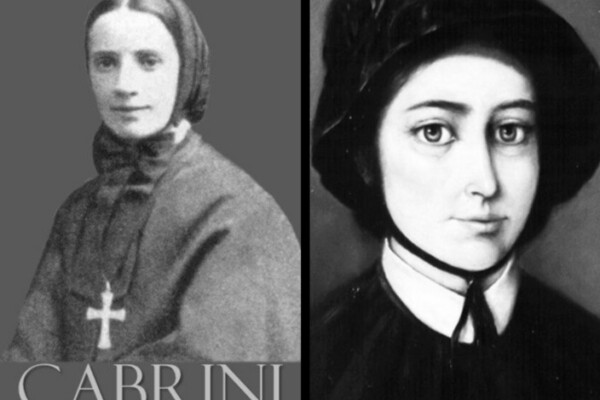
Mother Cabrini was convinced that Jesus’ “power working in us can do infinitely more than we can ask or imagine.” Not only was she convinced, she persistently acted out of that firm belief. Her life and missionary activity was the fruit of God’s power working in her and the dynamic network of divine and human relationships that resulted.

  • Jesus, you are the One who does everything. I am not even, as others say, an instrument in your hands. It is you who do it all and I am but a spectator of the great and beautiful work that you know how to do (Journal, Nov., 1892).

  • The wind roars, the sky darkens, treacherous waves engulf us, everything turns topsy-turvy. We are threatened with a terrible tempest—no matter! I must keep my word and with faith, trust and God’s grace, “I can do all things in him who strengthens me (Travels, Oct., 1895).

  • Through your mercy, you have made me a Missionary of your Divine Heart and I must, I will act as a Missionary, relying on your help which is never lacking. Let your voice sound within me and I shall go even to the farthest end of the earth to do all that you ask because the sound of your voice performs wonders (Journal, Sept. 1897).

Today, the challenges to the Cabrinian Family are just as great and our need for courage and energy continues to grow. Just like Mother Cabrini, we must go on repeating “I can do all things in him who strengthens me (Ph 3:14)."

The Church
Pope Benedict XVI, in his first encyclical God is love in 2004, addressed the essential challenge of being “planted in love and built on love.” For Benedict, love (and hence relationship) is a process that is always open-ended. As he says:

Love is never “finished” and complete; throughout life it changes and matures and thus remains faithful to itself…the love story between God and man consists in the very fact that this communion of will increases in a communion of thought and sentiment and thus our will and God’s will increasingly coincide (17).

Is not this exactly the thought behind the opening words of our Constitutions? Our very name, Missionaries of the Sacred Heart, expresses a way of life—we are to be bearers of the love of Christ to the world (Cs. 1).

General Chapter and the Church
The message of our XIV General Chapter of 2008 is linked to this integral vision of charity and relationship.

  • We seek to develop new forms of charity that are creative and imaginative (Starting Afresh from Christ), that will be more effective today in…new spaces for missionary involvement (Theological Reflection).

  • Similarly, Benedict maintains: As a community the church (and by implication the Cabrinian Family) must practice love. Love thus needs to be organized if it is to be an ordered service to the community (20).

  • Even the call for Strategic Planning of the Chapter can be seen in this light. Strategic planning is a call to discern together what are the most effective ways of “organizing” new “strategies of love” appropriate for the Cabrinian Family in its many missionary spaces throughout the world.

  • Benedict also speaks to those of us who are the personnel carrying out charitable activity on a practical level. More than anything (we) must be persons moved by Christ’s love, persons whose hearts Christ has conquered with his love, awakening a love of neighbor (33). Practical activity will always be insufficient, unless it visibly expresses a love for man, a love nourished by an encounter with Christ. My deep personal sharing in the needs and sufferings of others becomes a sharing of my very self with them (34).

  • Finally, the Church and the Institute today exist in a complex world, increasingly beset by mounting problems, conflicts and crises which often demand hard decisions and difficult choices for the future. In such times, inspired courage and creative wisdom are needed to seek and do God’s will with peace and vision.

Our own experience:
We too must be increasingly convinced that God is daily giving us the power for our “hidden selves to grow strong” so that we may be “planted in love and built on love” in every aspect of our lives. We must also remember that this promise applies to the accomplishment of God’s will and plan for our lives—not just our own “private plans.” Hence we need to continue to grow in personal and communal discernment.

Re-imagining charity is not just about redesigning our service of love to our neighbor. It is also about creatively imagining how we could be and how our lives could change if we really let “his power working in us …do infinitely more than we can ask or imagine ” As we celebrate this Feast of God’s Heart, may all our hope be in his promise to us.

Some questions for reflection and discussion:

  • How central and/or effective in my life is the conviction that “his power working in us can do infinitely more than we can ask or imagine”?

  • Do I bring the concerns, hopes, joys and sorrows of my ministry to my daily encounter with the Lord and my personal examen of the day’s activities?

  • In our “service of charity” do we have a genuine relationship both with our fellow collaborators as well as those we serve?

  • Are we aware of our responsibility in the Cabrinian Family to be “bearers of the love of Christ to the world”?

Contact UsSite Terms of Use Privacy PolicySite Index © 2006 Missionary Sisters of the Sacred Heart of Jesus